









- One sided adhesive tapes
- Packing tapes
- Coloured - marking tapes
- Electrical tapes
- Office tapes, adhesive tapes
- Slick surface tapes
- Metal adhesive tapes
- Masking crepe tape
- Masking special tapes
- Surface protection tapes
- Foam - sealing tapes
- Anti-slip tapes
- Self-adhesive rubber cut-outs
- Special tapes
- Textile tapes
- Warning and reflective tapes
- Double-sided adhesive tapes
- Electrical insulation material
- Glues
- Flexible stoppers, bumpers
- Velcro straps
- Primers - activators - cleaners
- Accessories for adhesives, applicators
When is a shredder needed in the office?
Convenient communication with people across the entire world and a vast database of available data are only a small fragment of the colorful mosaic of today's advantages. However, there are also certain drawbacks. The digital age favors sophisticated attacks on payment cards, online banking, or databases containing sensitive data. Fortunately, the aforementioned security risks can be eliminated relatively easily, and to a large extent, you can decide on the security of your data yourself.

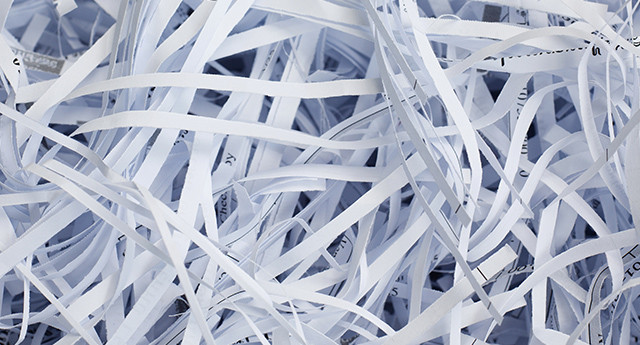
Large companies, as well as medium-sized or even small family businesses, do not forget to invest in the security of company laptops and desktop computers. What can please us, however, is the fact that companies are beginning to devote similar attention to printer security as well, which in the past was protected only minimally. Printers therefore also became a frequent target of cyberattacks.
Regulation (EU) 2016/679 of the European Parliament and of the Council, known by the acronym GDPR (General Data Protection Regulation), has increased the requirements for the protection of sensitive information. This is why protecting confidential information stored on computers or in printers has become an even higher priority for companies. Data protection would not be entirely complete, however, if you did not pay the same attention to information found on paper. And there are certainly more than enough of those in every company, despite strong digitalization.
The solution is a shredder
Every company works with sensitive information that definitely should not end up in the wrong hands or with the competition.We can mention accounting records, copies of business contracts, price quotations, employment contracts, and a large amount of other personal or business data concerning you, your clients, business partners, or employees.
It would, however, be very naive to think that such confidential information does not require appropriate handling. Of course they do, from the beginning of their archiving all the way to the very end. So if you do decide to get rid of them one day, it is certainly not a good idea to deal with it by tearing them into a few pieces and throwing them in the trash. The ideal method is a shredder that cuts the paper into hundreds of tiny pieces. You can be sure that no one can put them back together anymore, so a leak of sensitive information is out of the question.
Not only paper can be shredded
Shredders, like many other pieces of office equipment, offer versatility that provides a wide range of possibilities. In practice, for example, you can choose inkjet or laser printers, and in the case of a shredder, you do not have to limit yourself to shredding individual sheets of paper at all. Modern shredders can do much more. Thanks to some models, you can easily handle shredding CDs, credit cards, or even floppy disks. Stapled office documents or those fastened with a stapler or paper clip will not be a problem for the shredder.
From the customer's perspective, the choice of an office shredder can be greatly influenced by the level of protection this device is able to provide. This means that you need to choose a shredder based on how small it can shred documents containing sensitive information during shredding. Military or government documents will logically require a different level of confidentiality, while corporate documents will require another. To help you better navigate this topic, we will offer you a brief overview of classification levels.
The suitability of a shredder may be determined by the standard
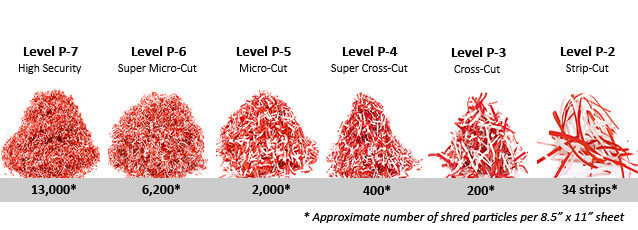
In general, the disposal of data carriers, including paper, is governed by the DIN 66399 standard. The DIN 66399 standard defines 7 security levels for different material classifications (P-1 to P-7). Within the levels of secrecy, as we have already indicated, a distinction is then made according to the size of the particles and the possibility of reconstructing the shredded material. According to the degree of classification, or rather, Based on the particle size, you can determine which shredder is suitable for your needs. Finally, we will just add that the higher the level of confidentiality, the higher the level of security and the smaller the size of the shredded paper particles.

Protection level P-1
Recommended for ordinary documents without sensitive data. Reconstruction of shredded data is possible even without expert knowledge, but it is time-consuming. The surface area of shredded paper particles may be max. 2,000 mm² or the strip width may have a maximum of 12 mm. The length of the strips is unlimited.
Protection level P-2
Suitable for basic documents with some less protected data (e.g. address). Reconstruction of shredded data is only possible with the use of auxiliary means, but it is still time-consuming. The surface area of shredded paper particles may be max. 800 mm² or the strip width may have a maximum. 6 mm, the length of the strips is unlimited.
Protection level P-3
Ideal for internal documents with more sensitive information. Reconstructing the data would require a lot of effort and financial resources. The surface area of shredded paper particles may be max. 320 mm² or the strip width may have a maximum. 2 mm. The length of the strips is unlimited.
Protection level P-4
Intended for confidential documents (e.g. bank statements). Reconstructing shredded data would require the use of equipment that may be available to specialized units. The surface area of shredded paper particles may be max. 160 mm² or the strip width can have a maximum. 6 mm.
Protection level P-5
Suitable for confidential and strategic documents. Reconstruction of shredded data is highly unlikely. The surface area of shredded paper particles may be max. 30 mm² or the strip width can have a maximum. 2 mm.
Protection level P-6
Used for classified documents with a high level of protection (suitable for security forces, legal and corporate documents with the highest priority). Reconstruction of shredded data excluded. The surface area of shredded paper particles may be max. 10 mm² and the strip width can have a max. 1 mm.
Protection level P-7
The highest confidentiality standard suitable for documents containing top-secret information. Reconstruction of shredded documents is out of the question. The surface area of shredded paper particles may be max. 5 mm² and the strip width can be max. 1 mm.